
Zionism, in point of fact, has always been the Siamese twin of anti-semitism. . . . The Zionists regard themselves as second-class citizens in Poland. Their aim is to be first-class citizens in Palestine and make the Arabs second-class citizens. — Henryk Erlich, Bundist and Menshevik leader, 1938
I’ve acknowledged my weak grip on Judaism, in spite of which, or maybe because of which, I knew I would absolutely have to read the new book by Molly Crabapple, “Here Where We Live Is Our Country.” It chronicles the life and death of the Jewish Labor Bund centered in the Pale of Settlement, parts of modern-day Russia, Belarus, and Poland.
Now as the Israeli fascist regime burns down the heritage of labor Zionism, Bundism is ripe for a comeback. Crabapple is one of the tribunes of this possibility. Another is the journal Jewish Currents. The most explicit activist incarnation is Jewish Voice for Peace. Crabapple happens to be a visual artist, but she is also quite a good writer.
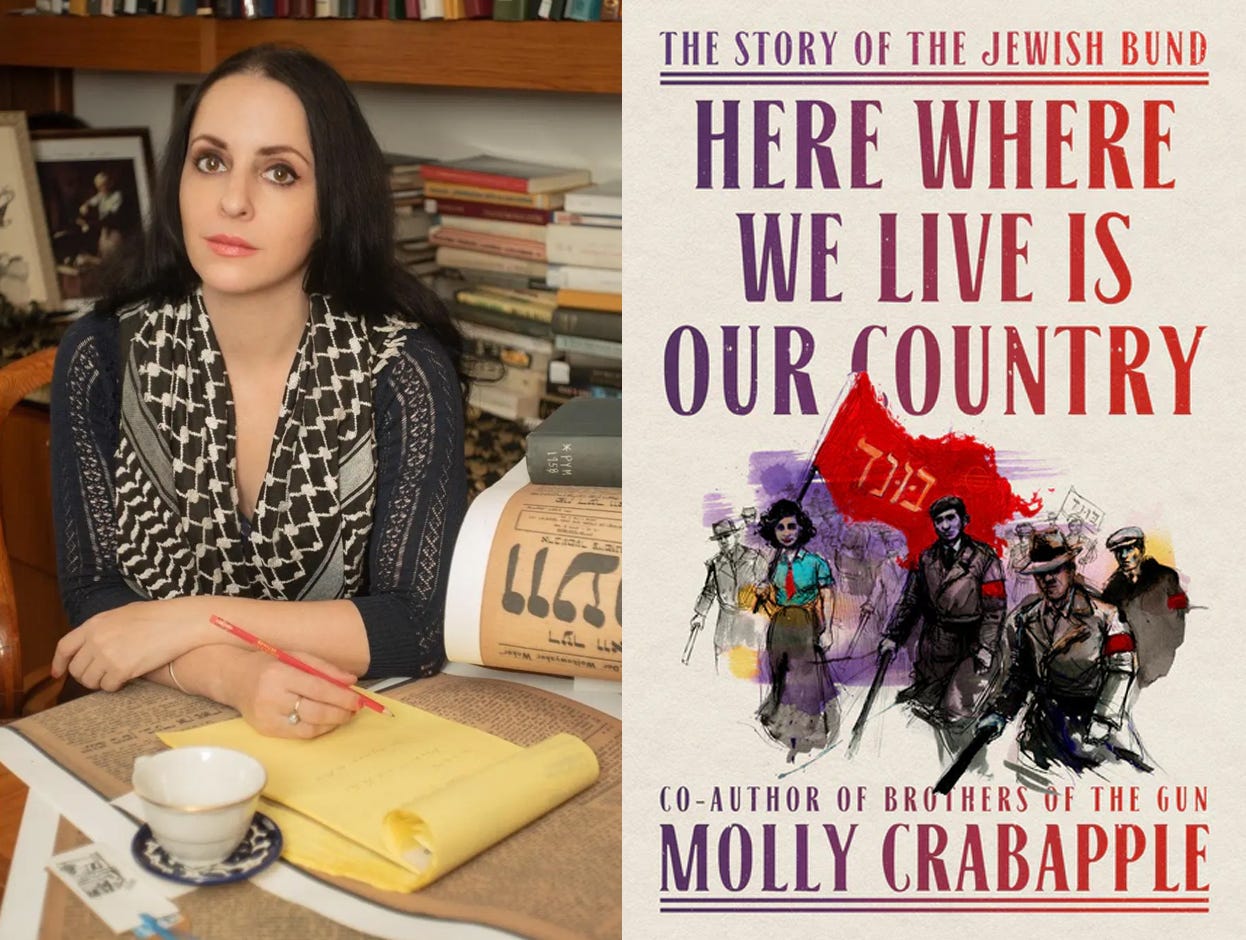
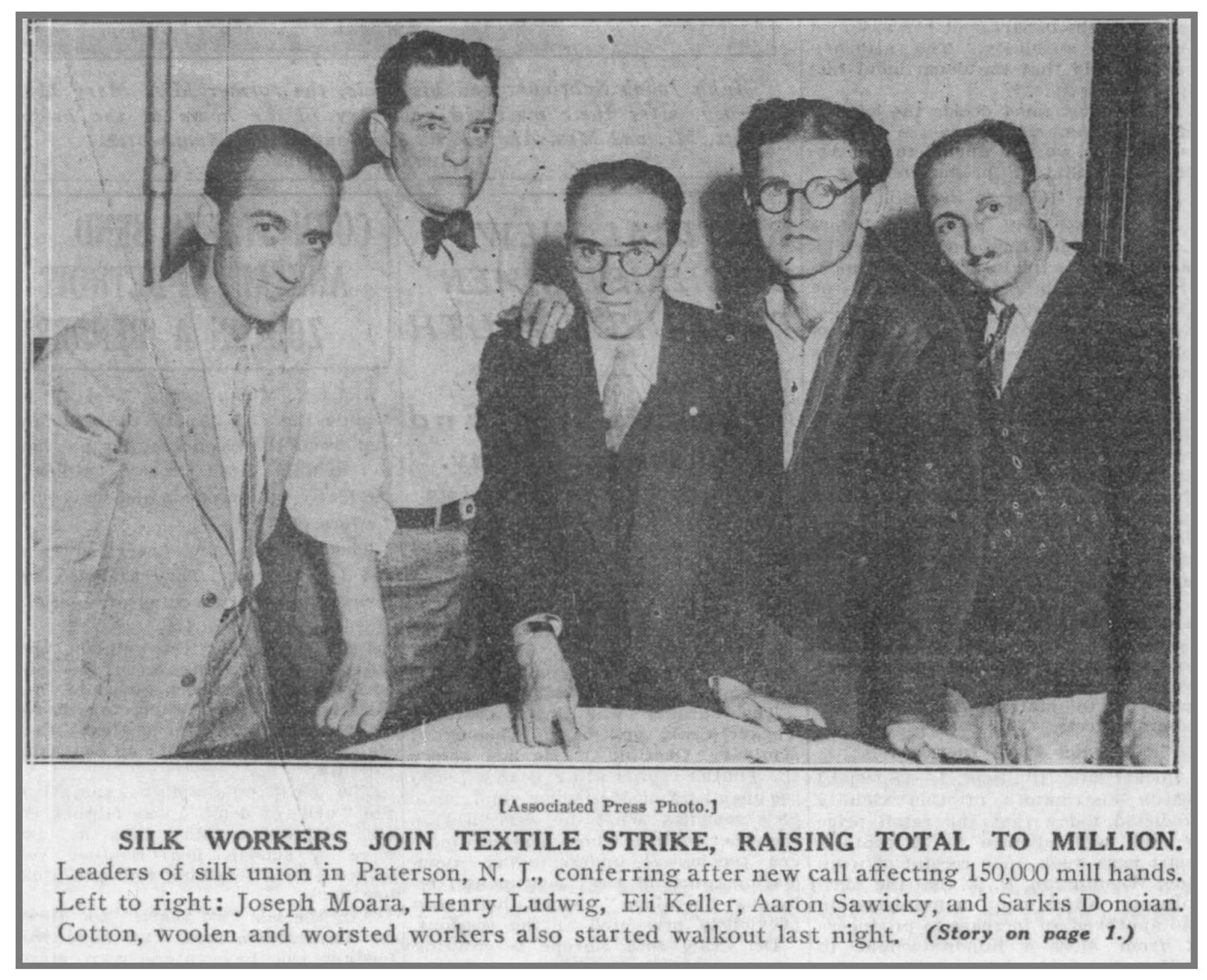
If I have a Jewish heritage, Bundism is it. Crabapple reports that the leaders of the massive U.S. garment workers’ unions, such as David Dubinsky and others, started as Bundists. My dad knew those guys, though he was born in Connecticut.
My other social connection is that one of my oldest friends was one of the brains behind this documentary, entitled “Resistance: Untold Stories of Jewish Partisans,” about armed Jewish anti-Nazi resistance in occupied Europe. To be clear, these incredible fighters were mostly Bundists, not Zionists. The film is interesting because it exploits propaganda footage concocted by the Soviet Union, in which Russian soldiers play the roles of German soldiers. When the production company, Great Projects Film Company, did a publicity tour for the film, I was able to meet one of the fighters who had come along. Very cool.
In contrast to the Zionist call for Jews to emigrate to Israel, which only built up a head of steam after 1930 because of Hitler, the Bund upheld the right of Jews to full equality wherever they happened to reside, starting before 1900. Moreover, the Bund insisted that the future of Jews lay in solidarity with the gentile working classes of their respective nations, fighting together for socialism. Those gentiles were often violently hostile to such possibilities, though there were heroic exceptions.
The determination to stay and fight has been described as “hereness,” in Yiddish “do’ikayt.” The fighting, by the way, was often physical. The Bund’s history is replete with the formation of defense squads that would patrol in places where Jews might be menaced. A U.S. analog was the “Deacons for Defense,” which consisted of black men who armed themselves to protect civil rights workers in the deep south in the 1960s.
The Zionists were the cynics, but you can’t say they were wrong. Europe indeed proved inhospitable to its Jews, who were persecuted or betrayed by a full spectrum of political tendencies. The Polish Socialist Party was often an honorable exception. The Bund insisted on staying put and fighting, and it was massacred, along with Jews of all classes. The Zionists bugged out, when they could. Maybe that’s harsh, but their survival is undeniable. So is their degeneration.
In fairness, the Zionists trapped in Warsaw did join the rest of the Jews who rose up to fight the German army. You could say they had no other choice, since by then the pending extermination of all Jews trapped in Poland had become apparent. Still, credit is due. That credit was subsequently forfeited as Zionists waged war on the Bund after liberation, to ensure that all those displaced during the war would be forced to go to Palestine. They even instituted a draft, enforced in refugee camps the Zionists took over, for a nation that did not yet exist.
In the early days of Nazism, according to Hannah Arendt, among others, the Zionists collaborated with fascists. Adolph Eichmann was once a dedicated Zionist. At the point when expulsion of Europe’s millions of Jews became impractical, the Nazi Final Solution was formulated. Some on the Left have tried to make hay of the links between Zionists and fascists, but the choice to collaborate was clearly made under duress, faced with the threat of liquidation. It’s easy to criticize from a safe place. By now there is no lack of ammunition with which to criticize Israeli policy.
Nazis and Zionist Jews, in bed together, in the 1930s? It’s not so implausible. In the U.S., the interest among the racist Right in sending black folks back to Africa has been a thing since the 19th Century. Among Zionists in Israel, it was the original “revisionist” wing, led by Mussolini-admirer Ze’ev Jabotinsky, that has now become ascendant. The revisionists thought that Israel ought to encompass not just the land west of the Jordan River, but Jordan as well. By now Jabotinsky’s ideological descendants have their eye on Southern Lebanon, Syria, and who knows what else. This was foreseen.
The Bund insisted on celebrating and creating autonomous Jewish culture and the language of the Jewish ghetto, Yiddish, while rejecting (sometimes mocking) Jewish religious devotion, as well as upholding socialism in solidarity with the entire working class. It may surprise a few, but the most explicit revival of this stance in the U.S. happened to have been the Black Panther Party, also reconciling what it called “revolutionary nationalism” with socialism. It’s a heavy lift.
Crabapple weaves this history together with the U.S. radical past. I would take it a bit further, as I have before. The Bund was an important precursor of the Russian revolution and its communist party. In this respect, the Jewish component of the European working class was a social vanguard of the broader movement.
In the U.S., African-Americans and POC are in a similar position. Economists speak of “segmented labor markets.” The segmentation serves the political purpose of obstructing working class unity. In Europe, it was the massive Bundist constituency that formed a vanguard, by virtue of its second-class citizenship, hardly a citizenship at all. The U.S. analogy is obvious. There is no shortage of socialists among POC in the U.S. Their disinclination to take charge of the Left, something clearly within their capacity, is important.
Another striking parallel to current events was the primacy of anti-immigrant or anti-refugee sentiment among gentile populations, who assumed a god-given right to reside in their native land and to deny such rights to others.
If there is a lesson in Bundism, it’s that revolutionary nationalism, however noble and uplifting, is compelling for the oppressed minority but hard to do. It depends upon a positive response from an indifferent, if not bigoted, majority.
There were bright spots of gentile aid to beleaguered Jews in the face of widespread, vicious anti-semitism in central Europe. In the end, it all came to naught. Those who made it out to Israel were saved, the others not. At the same time, as I’ve said more than once, Bundism does provide an off-ramp for progressive Jews stuck in socialist Zionism.
Crabapple turns this conclusion inside out. The Bund did not fail. Humanity failed. It failed to prevent the monstrous crimes culminating in the Holocaust. It failed to defend democracy in Spain. It failed to welcome refugees desperate to escape Europe, befoe, during, and after the war. It failed to bomb the infrastructure of the Final Solution. It failed to denazify post-war Europe.
I would suggest that the book is not a story about Jews. It’s about a uniquely persecuted people struggling to become human and striving to make others human. Ultimately there are no nations, ethnicities, religious faiths, political outlooks, gender identities. There is only humanity, seeking liberation.
A fundamental element of liberation is the ability to choosc a place to be. “[H]ereness” is itself fundamental. Judaism has been said to be a repository of the historical progress of Humanism. The Bund was its apotheosis, again not merely a Jewish thing. Israel, quite the opposite.
I heard Sam Seder interviewing Molly Crabapple on The Majority Report, then went out and bought the book. This is indispensable history for those who (like my daughters) seek to disentangle their Jewish heritage from what you, Max, might call Jabotinskyan Zionism.
Thanks, good overview. I'll read Crabapple's book soon. But on this: "The Bund was an important precursor of the Russian revolution and its communist party. In this respect, the Jewish component of the European working class was a social vanguard of the broader movement." Well, I'm no expert but see this by Dan La Botz: https://links.org.au/goodbye-lenin-and-leninism, where he says: "With the congress decision to form one centralised party rather than adopt a federalist approach, Lenin’s supporter essentially excluded the Russian socialists of the General Jewish Labour Bund, an organisation they viewed as nationalist and separatist. The Bund’s exclusion meant that Lenin’s followers were now the majority, or Bolsheviks, while Julius Martov’s adherents were the minority, the Mensheviks. With the Bundists out of the way, Lenin presented his plan for party organisation, What Is To Be Done?, leading to the debate with Martov and his followers." I'm following up by ordering via interlibrary loan this book: Antisemitism and the Russian Revolution by Brendan McGeever.