
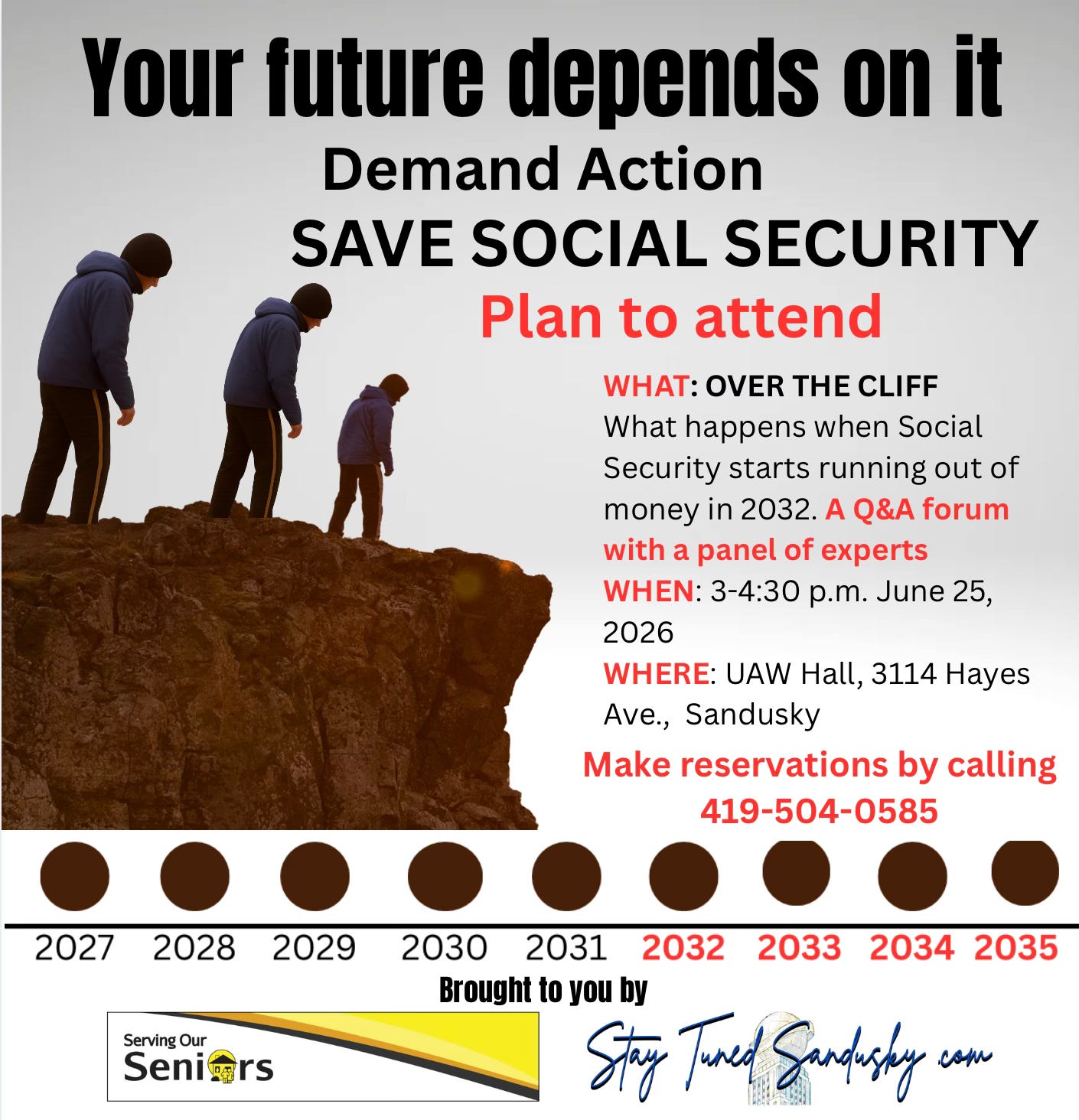
The call for benefit cuts is getting boosted again. I can admit my own interest, since the wife and I live well enough on those benefits. The bogus story is that the Social Security Old Age and Survivors’ Trust Fund (the formal funding source for the benefits paid to retirees and their survivors) runs out of money in 2032, at which point by law there must be a benefit cut of 22 percent. That’s the “cliff.” Don’t believe it. The Medicare Hospital Insurance Fund that pays for Medicare Part A is similarly scheduled to go to a zero balance in 2033.
It is true that, given the ignorance of the subject in the U.S. Congress and in popular discourse, combined with elite opinion, benefits for anyone could be reduced through legislation at any moment. In 2032 they would be reduced for lack of legislation. That they must be cut due to a sudden shortfall of money is the falsehood that has been circulating for decades. Indeed, I’ve been declaiming against it for my entire career. If I make it to 2032, shit could get real for me personally.
Let’s run through a few numbers, all of which you can find in the Trustees’ annual reports. Who are the trustees? They include Trump Treasury Secretary Scott Bessent and Robert F. Kennedy Jr., god help us. Sleepy Barack and Sleepy Joe failed to fill out the rest of the Trustee slots for public representatives with appointments they were empowered to make since 2015.
Consider Table 4 in this link. The cost of the Old Age and Survivors Insurance program in 2025 was $1,448 billion. That is mostly benefits, plus a tiny slice for administration of the program. The income to the Trust Fund, mostly from the payroll tax, was less, $1,248 billion. That means in accounting terms that general revenue supplemented income of the fund by $200 billion. The Fund income is mostly payroll tax revenue and interested credited to the Fund balance. The interest is purely an accounting entry. No actual money is deposited into the Fund, as it would be in your savings account at the bank. It’s really income taxes that finance the interest earnings of the Fund.
The difference between income and cost will grow as the Trust Fund balance diminishes and along with it, the interest it ‘earns.’ Until then, ye olde ‘general revenue’ (mostly the income tax) pays off the debt held by the Fund to the extent it supplements the Fund’s own income from the payroll tax receipts.
Between 2031 and 2033, years that bracket the year of projected Trust Fund exhaustion, there is no economic breakdown in Fund income. The general revenue used to make good on the debt held by the Fund, as well as the top-up to payroll tax revenue, can keep flowing. If you were cool in 2031, you are cool in 2033.
THE BREAK IS A LEGAL ONE — Congress must act to provide income tax revenue to supplement shortfalls between payroll tax fund income and program costs if the Trust Fund is empty and promised benefits are honored. There is no provision in law to provide the income tax revenue to prop up benefits and other costs. The failure of Congress to act would trigger the benefit cuts.
The villains in this piece include not a few economist friends from my former professional life, as well as financial industry predators circling the program like sharks, Washington Post editorialists (who predate Trump), corporate ‘Third Way’ Democrats, and other lifelong critics of the Welfare State.
It turns out that both sides in the debate have an interest in exaggerating or at least misstating the problem with the program.
The motives of those who want to wreck it are obvious enough. Their chief argument is that wealthy people receive high benefits, and the program’s resources would be better focused on the poor. Whenever they get the chance, these same swine tell us the poor should instead go back to work, rather than free-loading off the rest of us. Lately, a professor economics at Yale is getting pilloried for intimating that the aged of Japan should stop taking advaantage of old age benefits and commit seppuku (ritual suicide. Now he has apologized, saying it was an ‘abstract metaphor.’). I’m so old I remember when a Democratic governor from Colorado spoke in similar terms.
One rhetorical gambit of the attack squad is to claim that trimming the benefits will “modernize” or “save” the program. Naturally, Members of Congress who speak in these terms are never interested in modernizing their own generous pension benefits, nor in modernizing tax breaks available to the wealthy.
Then there are the antics of our friends, whose chief slogan is to “scrap the cap.” This is now an official bi-partisan legislative proposal from Senators Bernie Moreno (R-OH) and the saintly Elizabeth Warren (D-MA). They are referring to the payroll tax, presently capped at $184,500 in annual wages or salary. The cap is adjusted annually for inflation. An uncapped payroll tax would reduce the extent to which income taxes are needed to top up program revenues and pay promised benefits. Insofar as taxable payroll grows faster than inflation, a greater share of wages escapes exposure to the payroll tax every year.
Here I’m afraid I have to venture off the reservation.
Lemme tell you about “social insurance.” I may be the last social-democrat in the U.S. who appreciates the concept. The idea is that what you pay in has a lot to do with future benefits, as with a literal insurance policy. Since we are speaking of ‘social’ insurance, the equivalence is deliberately inexact. In fact, in Social Security the benefit-to-tax relationship is somewhat progressive; the higher-paid do not get as big a return on their tax payments as the lesser-paid.
My contention is that the social-insurance nature of the program has protected it from politicians, at least until now. Others liken Social Security to the celebrated so-called “Universal Basic Income” (UBI). But Social Security is not universal. Eligibility depends on a record of wage and salary tax payments. It is notorious that it was initially designed, in order to get legislative buy-in from racist Southern Democrats, to exclude disproportionately African-American domestics and sharecroppers. This is no longer an issue. Research has shown that Disability Insurance provides net gains to African-Americans.
Some cite the low life expectancy of minorities to criticize the program. Their numbers are usually off. The relevant life expectancy is of future workers; insofar as there is a racial difference in any life expectancy, that is not necessarily relevant to social-insurance. It is a scandal in other respects, but the correct age consideration is life expectancy conditional on reaching working age.
UBI enthusiasts claim that its universality (debatable, but that’s another post) would make it politically popular, “like Social Security.” I contend that Social Security is popular because of its social-insurance rubric. It’s a promised return of tax payments. A better analogy for UBI is Food Stamps (now renamed ‘Supplemental Nutrition Assistance Program’), which has been popular because of its size, hence quasi-universality. Note that this has not insulated it completely from cuts.
The problem with scrapping the cap is that it diminishes the link between payroll tax payments and benefits, hence the social insurance character of the program. The right-wing Tax Foundation understands this. The Left view of benefits is more like Big Rock Candy Mountain. The Gov should just be giving everybody money. Scrapping the cap makes Social Security more like UBI and exposes it to further political sabotage, since the higher one’s income, the less one would favor the program.
Proposals for how to make good on the higher taxes vary. Some would cap benefits after uncapping the tax. Good luck with that. Others would dole some of the increased revenue to the lowest earners, better, but may not assuage the political agita of the better-off.
The simplest thing to do in 2032 is just do whatever you did with income tax revenue in 2031, plus a bit more. No bridges would collapse. Whatever the deficit was in 2031 would not be much higher in 2032. Nobody ever refers to or even notices the change in the overall deficit, which you might have noticed has gotten pretty big, due to changes in Social Security costs.
One virtue of ‘scrap the cap’ is it capitalizes on a few popular, if naive, nostrums about taxes (tax the rich) and neutralizes those motivated by deficit concerns. And it is true, the Gov needs more revenue, though there are better ways to get it. My hero Dean Baker has noted that small incremental increases in the payroll tax that would hardly be noticed could fund the program indefinitely.
For those among the aged, such as myself, I should soothe your possible apprehensions by noting that in the past, proposals to cut benefits have always excluded already-retired beneficiaries and those above some cut-off age like 55, on the grounds that it would be too late for them to adjust their finances to cope with lower benefits.
For the young, I would remind you of the late Senator Moynihan’s point, that persuading people that the program is doomed makes it easier to take it away. There is popular commentary about the burden of the aged on everyone else, usually penned by those who don’t depend on Old Age benefits for basic expenses. But generations, ‘Boomers’ no more than anyone else, don’t make policies. The One Percent holds the reins.
Stop saying it won’t be there. That would be literally impossible, since there will always be payroll taxes to finance benefits at some level. As long as GDP grows, labor compensation will grow, and as long as that grows, so will payroll taxes (even if capped). If GDP stops growing, our problems will be bigger than financing Social Security. We could turn into Argentina, which used to be among the world’s biggest economies. A few more presidents like Trump and we would be on our way.
In conventional terms, the deterioration in the Trust Funds’ conditions, according to the Trustees — Trump appointees — are due to three factors: reduced immigration, Trump’s tax cuts, and a lower birth rate. You can find a few more rocks to throw at the Administration in the Trustees’ summary, but I think this is all beside the point.
I might also note that by the same fallacious reasoning applied to retiree benefits, the Disability Trust Fund is good until 2099. Perhaps this distinction will protect disabled beneficiaries from cruel and stupid policies, but I wouldn’t count on it. In the same vein, the “Supplementary Medical Insurance Fund” (SMI), according to the Trustees, “is adequately financed into the indefinite future” because it is funded from ‘general revenue’ (everything besides the payroll tax).
The economic reality is that none of the programs are less secure than the SMI. All of them are currently financed by general revenue. That is how the debt held by the Funds is made good, and how benefits that are promised could be paid in full. All we need are politicians who are not shitheads.
Fucking A+!
Max you typing oracle and icon
Pound on this till
the loaded dice everywhere
pop their pips