
Bernstein had to walk his statement back. It was too blunt for the German Social-Democratic Party, the most successful socialist organization ever. But he stuck to the basic idea, as we should. The biggest misconception on the Leftyer-Left is the confusion between end-states and process. Given its history, democratic socialism is all process. It’s evolutionary. Leninism, usually called communism, by contrast is an all-at-once/all-or-nothing thing.
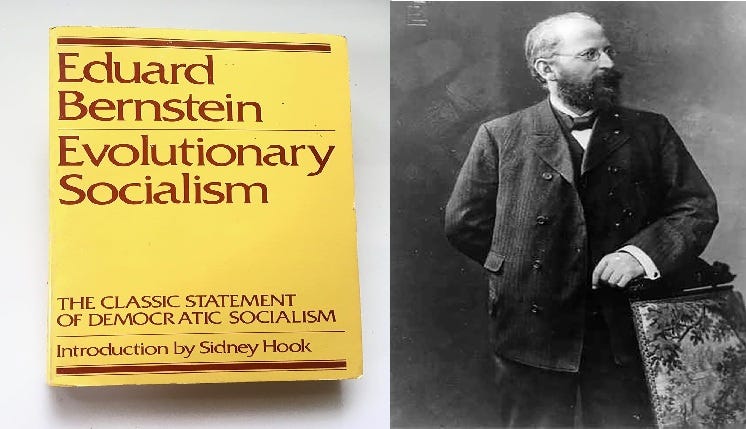
Democratic socialism has given us, piece by piece, the welfare state, with all its deficiencies, and likewise, trade unionism. Leninism in its usual conception (contradicted by Lenin himself, prior to 1917, not to mention Marx and Engels) had one dramatic, short-lived success and provided no lessons for subsequent political practice. It was a one-off. There were no repeats, not even close.
The Democratic Socialists of America (DSA) is progressing along democratic socialist lines. New York City Mayor Mamdani did not propose to nationalize the means of production, merely to provide some public grocery stores in areas of NYC known as “food deserts” (places where residents lack convenient access to supermarkets). He didn’t even suggest the city monopolize area grocery sales, which would have been bone-headed but consistent with some folks’ understanding of socialism.
As DSA progresses, now with 120,000 members, the nitwits on its National Political Committee debate how to hold it back, either by insisting on moralistic, impractical political stances or by demanding that use of a Democratic Party electoral line, that control of one of our two major parties, be foregone. A kiss of death, in other words.
Jacobin wunderkind ex-editor Bhasker Sunkara writes that he fears success will coopt the movement. It is certainly possible that progress could be slowed to a crawl. What people miss is that how to proceed by increments, small or not-so-small, is precisely the political problem. It is not solved by simply upholding the morally-satisfying maximum program. That is in fact an evasion, much like misguided urges for a third party or a ‘workers party.’
I’ve argued that democratic socialism is like a vector. It has a launching point (the current situation) and a direction. A vector has a length, or distance, and an end-point, but we only need the end-point to establish the direction. How fast and far we go is a tactical question. I’ve tried to explain how the logic of socialism differs from liberalism. We do not need to map out the ultimate objective in any detail. As we move forward, we will know what we are gaining and what we still need.
Another common misconception is to distinguish socialism from ‘social-democracy’ or liberalism by some kind of democratization of the economy. “People before profits.” Some stress public ownership of the “means of production,” an idea so vague as to be meaningless. Others speak of “workers control” (of what, exactly?). I honestly doubt many have a clue as to what any of that means.
Understanding public ownership as a principle is uninformed. Some things are better public than private, and vice-versa. There is no good reason for everything to be public. I’ve suggested the biggest priorities for public ownership.
I recently published a column explaining democratic socialism in one of our local newspapers. The objections are instructive.
One was to just yell socialism is not what you say, it’s communism and it’s bad bad bad. One alluded to my appearance as proof of his argument. It’s difficult to formulate an argument in a short comment, but none of them tried. It was all argument by assertion or bogus MAGA claims. This suggests the Mamdani approach can work, since the other side has no good response.
Another good essay Max. I especially like your framing of democratic socialism as a journey or evolution where communism was not.
One comment: Every successful "democratic socialist" nation (e.g., Western Europe, Japan, Canada, etc. that has single payer health care, generous pensions, etc.) has a hefty --- and regressive -- value added (or goods and services) tax. So nobody, especially the low and middle income households, are getting anything for free. Rather, those societies spread or "socialize" the financial risks of debilitating illness or disability, education, unemployment, poverty, etc. We sometimes try. But the US the health system attempts to do the opposite: a massive waste of time and resources trying to foist your health costs on somebody else.
If we are to socialize more risk in America (just doing health risk is a huge lift, obviously) then the tax system is going to have to get more regressive, not more progressive. Go ahead, tax the rich all you want, make them pay for other rich peoples' entitlements, but that will never be enough money to spread basic living insurance to everyone.
max, great work. I think I know where I can publish my delayed book on democratic socialism open access, but with an ISBN and a print-for-fee/mail option. I it aside but on 10/07/03 to focus on the war(s). I'll send you and Dan and Copy of the draft, let me know if you think I should finish it? Glad to share draft with any of your readers who email me at michaeladover@outlook.com I already cite you: A more realistic view of the nature of constitutional socialism was recently discussed by Max Sawicky, who—although he did should have specifically mentioned changes to the constitution for those nations that have them—argued, “The only tenable transition to socialism in the U.S. and the advanced industrial nations is by democratic, parliamentary means: elections and legislation. To be sure, it depends on organizing outside of elections themselves. But there is no prospect of any forcible takeover from the left.”